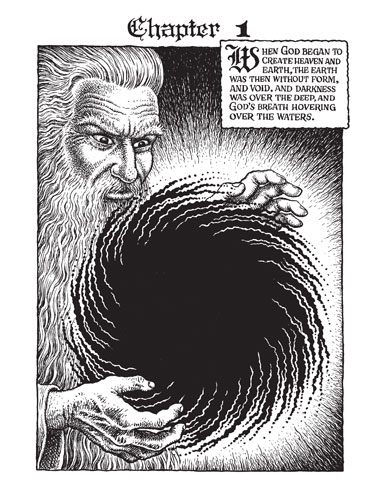
After spending five years researching, writing, and drawing, Robert Crumb, a lauded comic artist, published “The Book of Genesis.” This graphic novel leaves nothing out. Full of sex and war, this novel casts the foundational narratives of Judeo-Christianity in a whole new light.
What Crumb did in this book is bold, especially in a nation with such conservative mental claustrophobia. He illustrated a book of the Bible, and left no story untold, no scene un-shown. We like to leave the strange stories about Lot and his daughters screwing in caves or Abraham doing it with his wife’s slave out of our Christian Education Hour curriculum. Crumb includes these sexual scenes, and even shows us some boobs.
R. Crumb draws on a few different translations of the Hebrew text, as well as some artistic freedom, to illustrate every verse of the biblical book of Genesis. In his introduction, he says, “I, ironically, do not believe the Bible is ‘the word of God.’ I believe it is the words of men. It is, nonetheless, a powerful text.” But, let’s set theology aside, and look at the novel as a piece of art.
Crumb uses visceral images to present the text and culture with all of its taboos and nuances. This tears the Sunday school, flannel-graph, always-smiling Bible characters of my fond childhood asunder. He replaces the posh, happily robed flannel-graph Abraham with a balding man whose remaining hairs appear pubic. His facial expressions of love, mourning, war-rage, jealousy, fear, astonishment, pleasure, confusion, curiosity and sadness convey Abraham’s polyvalent relationship with the divine.
To me, all this raw re-representation of the familiar characters truly humanized the people that my Sunday school teachers stripped of their suffering. I can relate better with Abraham now that I see his face. Perhaps we share similar struggles in our relationship with God than I thought. He pleads with, bargains with, cries out to, and questions his Lord. And God is okay with that.
The gut-churning representations of the text show us how little we talk about the bizarre stories of the Bible. The foundations for out faith are laid out in stories told, written and edited through thousands of years in a dead language from a completely foreign culture. And they are not often represented as such. Not many preachers give a history or language lesson to help us understand these outlandish tales. They usually try to fit the complex puzzle piece of a passage into the current cultural jigsaw. They cover the passages in a thin film of simplicity, all the while ignoring the Ancient Hebrews and their culturally layered relationship to the stories.
Crumb doesn’t beat around the bush. And he doesn’t burn it either. Some will say that he profanes the sacred text and characters by drawing them. I think he makes the stories come alive.
“The Book of Genesis” is definitely rated R for content. Isn’t it interesting that said content is the foundation for our Christian understanding of the world? Crumb doesn’t theologize or change the stories of Genesis, he only shows us how strange and awkward they can be to see.


 Posts
Posts


No comments:
Post a Comment