Tuesday, December 22, 2009

A Million Miles in a Thousand Years (What I Learned While Editing My Life) by Donald Miller///Commentary by G. White


After reading Donald Miller’s new book, A Million Miles in a Thousand Years (wow, that’s hard to type all those l’s and i’s and m’s), I sat up on my couch and thought, dang, my life is boring. I kinda think that’s what Don wanted me to think. The premise of his book: live a better story.

After being approached by filmmakers, Don had to rewrite his life into a coherent, entertaining narrative for the common movie audience. He realized that his life was boring. He realized that his life was just a series of slightly related, yet somewhat distinct vignettes of writing, speaking, and smoking pipes.

In the Author’s Note, Miller questions us about film content. If we went to a movie about a guy who wanted to get a Volvo, and in the end he got a Volvo, we wouldn’t walk out of the theatre mystified or satisfied, we would wonder why anyone ever wanted to make that movie. Miller’s point: that’s your life. Your life is about silly things like getting Ipods and Volvos and about making the basketball team and getting that new job, but once we obtain those things, the story ends.

Miller says that most of our stories wouldn’t make good movies or even novels. We need to live better stories.

After thinking about this, I examined my life. I’m a junior in college with no idea what I want to do. To entertain myself I read books, watch movies and drink margaritas with my fiancé. Don talks about how his story got interesting, from kayaking in Oregon to biking across America to climbing the Inca Trail to Machu Picchu. And I sat there and thought, well, that’s easy for you Don because you’re probably bathed in cash from your successful books. I have to try and graduate with good grades so that I have a hope of getting a job and supporting my fiancé-soon-to-be-wife. I don’t have time to write a better story for myself. I go to a liberal arts college, where I’m getting a useless degree, I won’t be able to have your illustrious adventures.

But then I stepped back and realized that I’m having those adventures all the time. I’m writing a fairly good story, and soon Hannah and I will be permanently sharing a pen writing on the blank page of the rest of our lives.

Don talked about how a character needs to want something and to overcome conflict in order to get it. That’s a good story. I realized, I don’t know what I want, and I avoid conflict. So my story is pretty boring. But I decided to think of some things I want. I want to support my future spouse well. I want to pay off my debt in five years. I want to go to the Grand Canyon this spring break with my friends. I want to go to Spain with Hannah. I want to move to a big city. I want to go to grad school. I want to serve the poor and needy for the rest of my life. I want to love Hannah forever.

Now that I know what I want, I’ve got to overcome some conflict to get it. Well, Hannah, let’s make it to Spain and back. Josh, Jeff, Jordan, Matt: we’ll get to the Grand Canyon and enjoy every minute of it, even when we’re burying our own feces.

Miller challenged me to write a better story. I’m not sure if anyone will ever want to make my life into a movie, but hopefully we wouldn’t have much editing to do.

The book is challenging, hysterically funny, deep and wonderful. Miller tells the most beautiful, moving stories with his knack for humor, and with mature, yet humble insights.

Monday, December 21, 2009

Avatar


James Cameron didn’t spend three-hundred million dollars on a fresh story or good actors. He spent three-hundred million creating a beautiful, luminescent natural world that we should all feel bad destroying with capitalism.

The film opens up with a bird’s-eye-view of Pandora, a magnificent new world, explained as the moon of some other large planet. Quickly we realize why Pandora is valuable: unobtainium. A fake resource that the U.S. seems to want a lot of. There are references to a green-less earth back home, destroyed by America’s rape of the planet. The Army has established a base and a mining corporation partners with them to exploit Pandora for her precious unobtainium.

Enter Jake Sully, an ex-jarhead who lost his legs in combat. His brother was part of a project to make peace with the Na’vi, the native blue tall people of Pandora. Sigourney Weaver is the head scientist of the project and she’s not too happy to have another dumb gun on the planet to replace Sully’s now dead Ph.D. brother.

Weaver’s character, the treehugging and aptly named, Grace, has grown hybrid clones of the Na’vi with human DNA, and has found a way to mind meld with them. That’s where the title, Avatar, comes in. These copies can be inhabited “wirelessly” by people in coffin-like containers. Jake plugs in and is amazed to be able to walk and run again, and even have blue-people sex.

Then the story turns Fern Gully, er, I mean spy-falls-in-love-with-the-natives-and-changes-sides. Jake is sent on a mission by the grunting, white-haired Army commander to try to convince the Na’vi to move out of their tree village that sits on a large quantity of unobtainium. Jake goes, falls in love with blue princess, and conflict ensues.

Like I said, the plot isn’t too fresh or even interesting. But the world is. Pandora is a rain-forest by day and a fiber-optic glow show by night. It is a romanticization of the natural world that we have, a fossil of what may have once been on Earth. The Na’vi, blue people, are intimately connected with their world. I don’t mean that metaphorically. They can actually connect with some kind of organic internet that “flows,” like The Force, between all living things by taking their pony tails with nerves and attaching themselves to different animals and trees.

The Na’vi culture is an indigenous mixture with Native American leanings. They are a symbolic culture whose destruction Westerners mourn because of careless colonization and exploitation.

When Jake’s peace mission seems to fail, the caricature Army man decides to hit the massacre button. Cameron is unflinching in his accusations of America. Massacres like Wounded Knee, Sand Creek, and My Lai, are something that we tend to amnesiate into the academic periphery of our collective memory. But Cameron won’t let us forget.
The Army man goes painfully George Bush, “We have to fight terror with terror, we have to use pre-emptive strikes.” This blatant evoking of Bush-era rhetoric seals Cameron’s markedly green and blue message.

Avatar is preachy and romantic; the plot and characters are bland; the dialogue is spotty and cliché. But the message needs to be heard. Cameron used three-hundred million dollars to convince me that the Earth is something beautiful and bravura that we can lose through our undaunted avarice.

Sunday, December 20, 2009

Drops Like Stars


Rob Bell’s newest book, Drops Like Stars, is a coffee-table-book-sized illustrative collection of “thoughts on the suffering and creativity.” It is a short, yet expansive work of sleek design layout and evocative imagery. Most of the pages have a few words on them, punctuated by powerful images.

One of my friends picked up the book, leafed through it, and said, “This is trendy as frick.” But the lustrous, minimalist design certainly works. It is filled with beautiful images of soap carvings, to colorful Times Square, to a squirrel. The images back up Bells power-packed words. Bell’s previous books, Sex God, Velvet Elvis, and Jesus Wants to Save Christians, have all had similar designs: strong colors and sharp shapes, and straight lines. The space keeps you focused on the few words that are on the page.

Bell’s “thoughts on creativity and suffering” are divided into six “arts.” These arts are observations on the nature of suffering or its side effects. The first, disruption, is when our plans don’t go right, they get completely disrupted, and we have “to imagine a totally new tomorrow.” Honesty is the next art, which happens when people suffer and they have to express that suffering. Everyone feels “the ache” when they hear a story about human suffering. “Suffering unites,” which spells out solidarity, the fourth art. Bell talks about how we can all relate to Christ because he became flesh and suffered, just like the rest of us. We have solidarity with Christ. Elimination causes us to trim down to only what is necessary. This art coheres with the economic situation: Americans have had to eliminate extra things from their lives. The art of failure resides in the human ability to bounce back, evolve, and learn from mistakes.

In a recent interview with the Burnside Writer’s Collective, Bell said, “Great rhetoric has never been about how many words one can fill the air with, it’s always been about how clean and uncluttered and lean an idea can be articulated. It’s always been the short, crisp parable that has infinite layers of meaning that knocks around your head for days.” Drops Like Stars is just that. Bell doesn’t blab on and on for one-hundred and sixty pages. He puts a few strong words on each page and leaves space for readers to knock his ideas around.

Bell also said in the interview, “I’m endlessly interested in content—how to make something shorter, denser, get to it faster.” Drops Like Stars is a dense, short, thought provoking exploration of a question that most never ask about suffering.

Bell says that most people ask why? when it comes to suffering, but nobody really has the answer, even though there are volumes of explanations, they all fall short. So he asks a more practical, fresher question: what now?

Monday, November 23, 2009

Mexican Indigenous mother loses child because she can't speak english?

This is so outrageous. Some social services somewhere in Mississippi took a woman's baby away because she can only speak an indigenous tongue (not much Spanish and no English). Is this what immigration law has come to? Oh! you don't speak english, we'll take your kids now. Thank You! Have a nice day!

This is crap. If this woman loses her baby then I'll lose my faith in democracy. Let me explain. Democracy has produced one of the most confusing, intricate and absolutely impossible immigration systems in the whole world. It doesn't even make sense to the people who enforce it.

Check this and this out. It's more confusing than the Bible. It's impossible to get here unless you're a billionaire or whatever.
Let's remember that there are desperate humans all over the world who look to the United States as a symbol of hope to change their miserable lives, but when they apply, it ends up taking twenty years to become a citizen. Can you imagine if you had to wait twenty years for anything. That's about as slow as dial-up. We need to take some responsibility and change this legislation.

I have a friend who recently told me about his family's immigration story. His dad applied 3 years before my friend was even born, and didn't hear back from the U.S. till my friend was 12. That means he waited fifteen years to get in. I spoke with his dad who said that coming to the U.S. was the most difficult thing that ever happened to him because he had to come first, then his sons, then his wife, then his daughters. He told me that they came in four stages like that. They are completely legal, which is entirely rare because of the insane process and expense.

If we want people to come here legally, let's make it a little easier on them.

that's all.

-g

Sunday, November 15, 2009

The Fall of the Flannel Graph


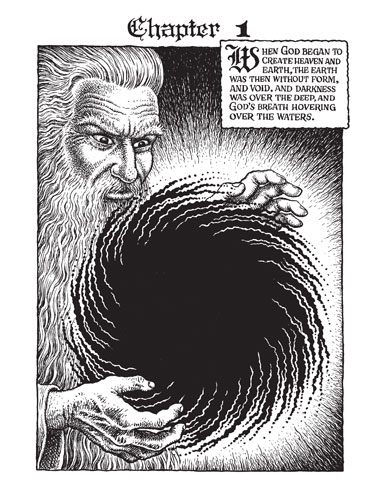
After spending five years researching, writing, and drawing, Robert Crumb, a lauded comic artist, published “The Book of Genesis.” This graphic novel leaves nothing out. Full of sex and war, this novel casts the foundational narratives of Judeo-Christianity in a whole new light.

What Crumb did in this book is bold, especially in a nation with such conservative mental claustrophobia. He illustrated a book of the Bible, and left no story untold, no scene un-shown. We like to leave the strange stories about Lot and his daughters screwing in caves or Abraham doing it with his wife’s slave out of our Christian Education Hour curriculum. Crumb includes these sexual scenes, and even shows us some boobs.

R. Crumb draws on a few different translations of the Hebrew text, as well as some artistic freedom, to illustrate every verse of the biblical book of Genesis. In his introduction, he says, “I, ironically, do not believe the Bible is ‘the word of God.’ I believe it is the words of men. It is, nonetheless, a powerful text.” But, let’s set theology aside, and look at the novel as a piece of art.

Crumb uses visceral images to present the text and culture with all of its taboos and nuances. This tears the Sunday school, flannel-graph, always-smiling Bible characters of my fond childhood asunder. He replaces the posh, happily robed flannel-graph Abraham with a balding man whose remaining hairs appear pubic. His facial expressions of love, mourning, war-rage, jealousy, fear, astonishment, pleasure, confusion, curiosity and sadness convey Abraham’s polyvalent relationship with the divine.

To me, all this raw re-representation of the familiar characters truly humanized the people that my Sunday school teachers stripped of their suffering. I can relate better with Abraham now that I see his face. Perhaps we share similar struggles in our relationship with God than I thought. He pleads with, bargains with, cries out to, and questions his Lord. And God is okay with that.

The gut-churning representations of the text show us how little we talk about the bizarre stories of the Bible. The foundations for out faith are laid out in stories told, written and edited through thousands of years in a dead language from a completely foreign culture. And they are not often represented as such. Not many preachers give a history or language lesson to help us understand these outlandish tales. They usually try to fit the complex puzzle piece of a passage into the current cultural jigsaw. They cover the passages in a thin film of simplicity, all the while ignoring the Ancient Hebrews and their culturally layered relationship to the stories.

Crumb doesn’t beat around the bush. And he doesn’t burn it either. Some will say that he profanes the sacred text and characters by drawing them. I think he makes the stories come alive.

“The Book of Genesis” is definitely rated R for content. Isn’t it interesting that said content is the foundation for our Christian understanding of the world? Crumb doesn’t theologize or change the stories of Genesis, he only shows us how strange and awkward they can be to see.

Thursday, November 12, 2009

On idiolect in community

My fiancé recently informed me that my group of friends from back home and I don’t really have conversations, we just joke. If I were and unreasonable person, which most men are, I would have told her off, but since I am reasonable, I sat back and thought about what she said. I examined the topics and style of our conversation and realized that we don’t really talk about anything. We just fling phrases and laugh. We have our own language of humor that we all enjoy when we come together, so we don’t rely on each other for deep, intense conversation. Our “idiolect” or “private tongue” can be inclusive and exclusive. We feel like members of our community because we can contribute to the ocean of jokes. But my fiancé feels excluded because she wants to have a real conversation and she doesn’t feel welcome we just gossip and joke in a foreign idiolect. I don’t blame her. Try to budge yourself into a group of people who are already friends. Their idiolect (inside jokes, funny words, and communicative nuances) is probably deeply developed. If you want to break into a group of people, you have to learn their idiolect. It will take patience and failure. And perhaps, in the process, you will realize that you don’t want to be part of the group, but I dare you to try.
We’ve been told before that on Second East Coly, we “speak a language of our own.” This is true. It is the idiolect that we have developed from common triumph, trial, fun and failure. We know how to talk with each other, whether it is a storm of nonsense, or a deep conversation.

Friday, November 6, 2009

an enexpected party

I’ve recently decided to revisit J.R.R. Tolkien’s “The Hobbit.” I read it almost eight years ago when I was a seventh-grader. I couldn’t remember many details. But I remember enjoying the battles like most pre-teen boys. I remember skipping the brilliant and rhythmic poems and songs. I remember thinking of Bilbo as a small, prickly creature who lived in a dirt tunnel. I remember imagining each of the dwarves and their strangely colored beards tucked into their belts and their hunger for adventure and wealth. That was before Hollywood corrected me.

Bilbo, our burglar and protagonist, is satisfied with a quiet, boring life and a vast inheritance in a comfortable home. He meets a mysterious wizard one morning, who graciously proposes an adventure. Bilbo rudely declines for the sake of his after-second-breakfast-smoke. Half an hour later, thirteen dwarves knock on his door and barge in without invitation. They propose the adventure. Bilbo leaves behind his lifestyle of five meals a day and they all set out to get their treasure from the evil dragon Smaug. As soon as they leave the placid Shire and venture into the outside world, madness ensues: they meet trolls, goblins, evil wolves; they fly on eagles, get kidnapped by elves and fight a colossal battle. I’ve taken a journey of sorts in the eight or so years since I last read this lauded classic. I was probably a foot shorter in those days, with no hope of ever getting a girlfriend or being good at anything but digging those big boogers out of my nose. Well…I still pick my nose, but I do have a fiancé now, so there is hope after all.

At the end of high school, the adventure known as ‘college’ was knocking on my door, but four years seemed like an inconvenience, like too long of a break between first and second breakfast. I didn’t want to go on that adventure with strangers. I didn’t want to leave the comfort and solace of everything and everyone I had ever known.

But I did. And like Bilbo, I’ve looked back fondly on the simpler times. But in my adventures at Northwestern I have mooned people from the windows of the children’s library, totaled my roommate’s car, dropped TVs from the bleachers just to hear them explode, and it’s been a pretty good time. I’ve travelled to the beach, the desert, the mountains and to lakes. I’ve ministered, learned, written, cried, puked, laughed and slept my way through college. I’m no Bilbo, but adventures are fun every once in a while.